

Published by Cartel DocsAbout 13 minutes to read
Investigations
Contents
In October 2019, as demonstrations spread across Lebanon, Noah Zaiter had a message for the people of Baalbek: take a Lebanese flag and go to the square[20]. According to AFP’s account of his video, he wore a backward baseball cap, a hoodie and a chain[20]. A man wanted by the authorities was addressing citizens demanding an end to corruption[20]. In Beirut, the agency found graffiti proposing him for president[20].
There was something almost routine about the contradiction[20]. Zaiter—also rendered Nouh Zeaiter—had made himself recognizable while remaining beyond the state’s immediate reach[20]. He could be absent from a courtroom and present on a screen[20]. The public performance did not erase the warrants[20]. It helped create the impression that warrants were something he could live with[20].
That impression lasted until November 20, 2025[5],[21]. Lebanese military intelligence arrested him on the Kneisseh–Baalbek road[5]. The army described surveillance followed by an ambush; his lawyer subsequently said he surrendered once surrounded[5],[21]. The man had finally entered custody[5]. The accumulated cases, however, did not become one simple prosecution[5],[21].
A familiar face beyond the courtroom
Zaiter’s willingness to appear publicly preceded the protests[8]. A 2023 profile by Asharq AlAwsat’s Nazeer Rida described years of media attention, particularly documentaries from the late 2000s onward[8]. Acquaintances portrayed him distributing money and presenting himself as a victim of neglect[8]. Those accounts supplied the ingredients of a local benefactor’s image, even as the authorities pursued him[8].
He also drew his own boundaries around the business[7]. The National later recalled a 2016 Al Jadeed interview in which he acknowledged growing and selling cannabis but rejected the description of a drug mafia leader[7]. The admission made him unusually visible; the denial challenged the scale and meaning that others attached to it[7]. It was possible to concede one activity while disputing the criminal empire built around his name[7].
The image circulated beyond news interviews[15]. In a 2018 study for the Moshe Dayan Center, Moran Levanoni described fan pages and photographs displaying Zaiter’s support for Hezbollah[15]. Another page identified him with the fictional protagonist of the television drama al-Hayba [15]. The resemblance offered admirers a ready-made character: the powerful borderland man who could stand outside ordinary authority[15]. Fiction supplied the glamour[15]. It could not establish what the real man had done[15].
The territory behind that image had a much longer history than his celebrity[27]. A 2017 Global Initiative study described civil-war arrangements between traffickers needing access to routes and militias seeking income[27]. Such bargains joined commerce to armed power without necessarily creating a single organization[27]. A trader might need protection, a militia might need revenue, and both could find reasons to cooperate without surrendering their separate interests[27].
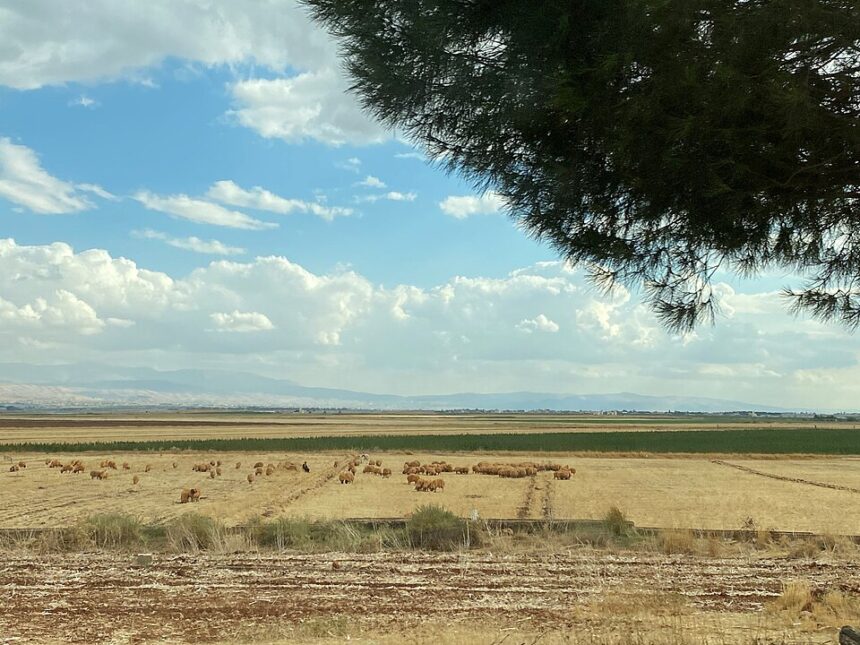
Nor had the state simply ignored cultivation[28]. The International Narcotics Control Board reported renewed cannabis growing in the Bekaa in 2002 despite eradication efforts[28]. Repeated destruction could remove a crop without removing the conditions that made another planting attractive[28]. The landscape was therefore familiar to enforcement agencies long before Zaiter became its most conspicuous face[28].
Lebanon’s own Agriculture Ministry acknowledged the difficulty[29]. Its 2003 account of the Baalbek–Hermel development program said the original objective of replacing cannabis and opium with alternative crops and livestock had not been achieved[29]. The program had moved toward broader rural development, including irrigation, credit and services[29]. That history helps explain why appeals to neglected communities could resonate[29]. It does not make a powerful trafficker representative of every farmer, or turn poverty into an explanation for every alleged offense[29].
Mohanad Hage Ali’s 2025 Carnegie study places the distinction inside the networks themselves[12]. Clan-rooted cannabis businesses and the newer Captagon entrepreneurs did not operate identically[12]. Kinship, local economic interests and mediation by political parties overlapped, while some synthetic-drug networks crossed those boundaries[12]. The resulting map was more complicated than a party hierarchy with every grower waiting for instructions at its bottom[12].
For Zaiter, that complexity mattered[12]. The question was not merely who liked him or appeared beside him[12]. It was which relationships could provide access, which could discourage confrontation and which would survive when the political circumstances changed[12]. Public prominence showed that he was not invisible[12]. It did not, by itself, explain why he remained free[12].
The war arrives at the farms
The Syrian war altered the priorities along Lebanon’s eastern frontier[19]. In 2015, drug-enforcement chief Ghassan Chamseddine told TIME that border defense had absorbed troops needed for crop eradication[19]. Growers presented their weapons as protection against jihadist incursions[19]. The general rejected that patriotic explanation, calling it a way to gain popular support for their business[19]. His account described a state choosing among urgent threats, not a formal immunity agreement with every armed farmer[19].
That same year, pictures presented as showing Zaiter visiting Hezbollah positions in Qalamoun provoked a public controversy[16]. CNN Arabic reported both the images’ circulation and Hezbollah’s denial[16]. The dispute made his political associations part of the national conversation[16]. It also exposed a problem that would recur: photographs could create a powerful impression of proximity without establishing the transactions or orders that lay behind it[16].
Hage Ali describes Zaiter as publicly supportive of Hezbollah and the Syrian regime while denying involvement in Captagon[12]. The distinction was central to his self-presentation[12]. Cannabis could be cast as a local livelihood; synthetic pills carried a different regional reputation and a different set of allegations[12]. By the time international sanctions arrived, the argument over what kind of dealer he was had become inseparable from the argument over whom he served[12].
The markets were changing around that argument[30]. In 2022, L’Orient Today interviewed farmers facing higher costs and falling hashish prices[30]. The army explained that clandestine pill production was easier to conceal than cannabis cultivation spread across agricultural land[30]. A field and a hidden production site posed different enforcement problems[30]. Those changes widened the economic opportunities available to traffickers, without proving that every cannabis grower—or Zaiter himself—had moved into pill manufacture[30].
The army could still strike material assets[4]. On February 26, 2019, it announced a raid on a farm it attributed to Zaiter and his brother Zouheir at Riha–Marah al-Mir[4]. The statement described a drug-production facility and cannabis estimated at twenty truckloads[4]. It was a substantial seizure, expressed in the rough measure of loads rather than a published weight[4]. It was not the arrest that would end his public career as a fugitive[4].
Months later, he was delivering his protest message[4],[20]. The contrast was stark: the army could announce the removal of his alleged stock, while he could still address an audience[4],[20]. For the viewer, the public appearance was immediate[20]. The process that might eventually compel him to answer the allegations remained distant[4],[20].
Judgments could accumulate while the defendant stayed away[7],[21]. The National reported that a military court sentenced him in absentia to life imprisonment with hard labor for drug offenses in 2021[7]. The sentence was severe; its practical limitation was equally obvious[7]. He was still outside custody[7]. Years later, his lawyer would describe arrest as the beginning of new, in-person proceedings[21]. That distinction gave the story a second clock: the years spent pursuing him, and the time required to hear cases once he was finally brought before a court[7],[21].
Washington names the relationships
On March 28, 2023, the US Treasury put a more explicit account into the public record[10]. It described Zaiter as having close ties to the Syrian Fourth Division and to “certain members of Hizballah.”[10] It also said he reportedly conducted illicit activities under Fourth Division protection[10]. Those were specific administrative allegations about relationships and support, extending beyond the symbolism of photographs[10].
Treasury designated him under the amended Executive Order 13224 for material support to Hezbollah[10]. That action belonged to a sanctions system, not to a Lebanese criminal trial[10]. Britain designated him the same day under its own measures, including financial restrictions and a travel ban[11]. The two governments were trying to constrain people they identified as participants in a regional drug economy[10],[11]. Their actions did not place him in a Lebanese prison[10],[11].
Zaiter answered in political language[9]. Enab Baladi reported that he rejected the allegations and treated the sanctions as a badge of honor[9]. Its account also discussed photographs linking him socially to figures including Wassim al-Assad[9]. His response fitted the persona already familiar to his audience: an accusation could be recast as evidence that powerful enemies had singled him out[9]. The photographs added to that persona, but remained a different kind of material from proof of a particular shipment[9].
Researchers looked at the same territory from a wider angle[13]. INSS’s 2023 analysis, Narcos Syria-Lebanon Style, described illicit networks expanding through the Syrian war and the involvement it attributed to regime-linked and Hezbollah-linked actors[13]. It also recorded Hezbollah’s denial of drug involvement[13]. The analysis helps situate the sanctions within a regional economy; it does not decide an individual Lebanese case[13].
The distinction between organizational ties and total control remains essential to understanding why Zaiter endured[12]. Hage Ali’s account shows clans with economic interests of their own and political intermediaries bargaining with them[12]. Armed capacity, cross-border access and connections to influential figures could reinforce one another[12]. None requires imagining that a single office authorized every movement or every confrontation[12].
Then the regional framework changed[14]. Bashar al-Assad’s government fell in December 2024[14]. Caroline Rose’s October 2025 CTC analysis described an illicit trade moving away from the old state-centered structure toward more fragmented entrepreneurial networks[14]. She distinguished the dismantling of laboratories from the harder work of disrupting organizations and relationships[14]. Removing a governing patron did not automatically remove the people, knowledge or commercial incentives that had accumulated under it[14].
The road to custody
In November 2025, the costs of enforcing state authority were visible in Baalbek[25]. Two soldiers, Bilal al-Baradei, 44, and Ali Haidar, 32, died during a November 18 raid in Al Sharawneh, according to the army account reported by The National[25]. Three other soldiers were wounded[25]. This was a separate operation, not an established charge that Zaiter had caused their deaths[25]. It showed the danger against which subsequent arrests were being measured[25].
Officials were also speaking about what the force lacked[25]. The same report quoted calls for equipment and material support, describing an army stretched by several security demands[25]. Such constraints do not settle why a particular fugitive escaped for years[25]. They do make the familiar phrase “the state was absent” insufficient: soldiers were entering these neighborhoods, sometimes at lethal cost[25].
Two days after that raid, Zaiter was in custody[5]. The military’s statement used his initials and listed allegations involving narcotics, weapons, armed robbery, attacks on soldiers and ransom kidnappings[5]. It said intelligence officers had caught him in an ambush after surveillance on the Kneisseh–Baalbek road[5]. Those allegations defined the breadth of the pursuit; they were not a verdict on every file[5].
Enforcement reached him in stages
A farm seizure was not the same event as his eventual capture.
The army announced a seizure at a property attributed to the brothers. [4]
The accounts of the encounter contained an important common point and different emphases[6],[21]. A senior military official told AP he surrendered following a standoff[6]. In a Reuters interview the next day, his lawyer Ashraf al-Moussawi described an ambush, encirclement and a voluntary surrender without resistance[21]. The lawyer’s version did not deny the security operation[21]. It emphasized how his client behaved once it had succeeded[21].
The capture immediately invited political explanations[26]. L’Orient Today placed it amid Gulf pressure over trafficking and pressure on Lebanon to disarm Hezbollah[26]. Its headline deck quoted a lawyer suggesting that Hezbollah might have let Zaiter go to relieve American pressure[26]. That was a proposed explanation for the timing, not a documented bargain[26]. Arrest had ended the uncertainty over whether he could be caught; it had not resolved the argument over why it happened then[26].
Moussawi was already looking past the arrest[21]. Speaking to Reuters on November 21, he said his client now faced in-person proceedings rather than the accumulated judgments issued in his absence[21]. He asked for speedy trials—and for a general amnesty[21]. The change in strategy was immediate[21]. A fugitive’s legal exposure was becoming a detained defendant’s procedural battle[21].
Forty files, more than one outcome
By February 2026, the public figure looked different in court[1],[21]. AlModon reporter Farah Mansour described Zaiter sitting through the hearing, weakened during a prison hunger strike, handling the microphone in front of him[1]. He told the court that he had surrendered voluntarily and denied the ambush account[1]. The words shifted the emphasis again: his lawyer had described surrender after encirclement; Zaiter now presented surrender as his own decision[1],[21].
The military court dealt with forty minor-offense files[2]. Reports recorded four convictions carrying one month each, three acquittals for insufficient evidence and thirty-three files falling away because of time limits[2]. Those outcomes were different things[2]. An acquittal assessed the evidence; a time bar prevented an old prosecution from continuing[2]. Neither meant that all the allegations attached to his name had been adjudicated[2].
Forty files, three kinds of outcome
The minor-offense cases reported in February 2026.
His lawyer Saliba al-Hajj stressed that serious cases involving drugs, murder and firing on the army remained[3]. The short sentences attracted attention precisely because they appeared so small beside the reputation[3]. But the reputation and the procedural schedule were not interchangeable[3]. The court was not sentencing the entire public image in one afternoon[3].
Zaiter continued to dispute the substance[2]. L’Orient Today’s account of an earlier hearing reported his admission of cannabis cultivation between 2005 and 2008, followed by his claim that he had switched to potatoes and oats[2]. He denied trafficking drugs and arms[2]. The courtroom required those claims to be considered beside particular allegations, rather than accepting either his self-description or the nickname “drug baron” as a substitute for a case[2].
A separate Beirut criminal proceeding encountered a mundane obstacle[17]. On April 27, This Is Lebanon reported that other defendants had not been notified of the hearing, and that the court had postponed the matter to October 19[17]. A man who had evaded capture for years was now waiting on service of notices[17]. The scheduled date alone says nothing about the eventual result[17].
Another route out
By October, the amnesty question his lawyer had raised at the outset was back at the center of the story[23]. On October 13, Moussawi predicted that Zaiter might soon be released[23]. His argument rested on how the law treated prior final convictions and repeated offenses, while acknowledging that courts would have to apply the conditions to individual files[23]. It was a defense forecast, not a release order[23].
A separate Lebanon Debate report quoted an unnamed senior judge arguing that the interpretation could benefit Zaiter in some cases[18]. It also distinguished that possibility from release: resolving particular files would not necessarily dispose of every reason for detention[18]. Two days later, AlMarkazia’s legal discussion stressed case-by-case implementation and the boundary between constitutional interpretation and changing legislation[22].
The debate sharpened rather than closed[24]. In an October 22 commentary, Nidaa alWatan writer Samer Zureiq criticized an interpretation he believed could benefit traffickers, and described a subsequent prosecutorial response[24]. The competing positions concerned the way the law would be applied[24]. None of those accounts, by itself, established a final disposition of Zaiter’s remaining cases[24].
For years, Zaiter had spoken from outside the system pursuing him[1]. At the February hearing, Mansour reported a smaller request[1]. Asked what he wanted, he sought acquittal and a transfer within Roumieh so he could see his family and lawyer[1]. The man who once urged a city into the square was asking a court where he would be allowed to sit[1].
Sources
- Farah Mansour, AlModon, Zaiter before the military court (3 February 2026)
- L’Orient Today, Nouh Zeaiter sentenced on minor offenses (3 February 2026)
- LBCI, Zaiter’s lawyer distinguishes felony cases (3 February 2026)
- Lebanese Army, seizure at Zaiter farm (26 February 2019)
- Lebanese Army, arrest of N.Z. (20 November 2025)
- AP, Lebanon’s most wanted drug trafficker taken into custody (20 November 2025)
- Jamie Prentis, The National, Lebanon captures Nouh Zaiter (20 November 2025)
- Nazeer Rida, Asharq AlAwsat via MTV, Zaiter and Daqqou (29 March 2023)
- Enab Baladi, Zaiter and Daqqou Syrian Captagon connections (31 March 2023)
- US Treasury, Syrian and Lebanese drug actors (28 March 2023)
- UK FCDO, Tackling the illicit drug trade fuelling Assad’s war machine (28 March 2023)
- Mohanad Hage Ali, Carnegie, Double Dealers (19 March 2025)
- Valensi and Mizrahi, INSS, Narcos Syria-Lebanon Style (19 January 2023)
- Caroline Rose, CTC, The Future of the Illicit Captagon Drug Trade (October 2025)
- Moran Levanoni, Drugs, Shi’a and the Struggle for Southern Syria (2018)
- CNN Arabic, Zaiter’s Qalamoun photos and Hezbollah denial (15 September 2015)
- This Is Lebanon, Zaiter trial postponed (27 April 2026)
- Lebanon Debate via Lebanonmirror, amnesty interpretation (13 October 2026)
- TIME, Lebanon’s Hash Farmers Join the Fight Against ISIS (12 February 2015)
- AFP, Drug lord delivers blunt Lebanon protest support (24–25 October 2019)
- Reuters Connect, lawyer interview (21 November 2025)
- Yola Hashem, AlMarkazia, constitutional amnesty dispute (15 October 2026)
- Ashraf al-Moussawi interview, Lebanon Debate via Lebanonmirror (13 October 2026)
- Samer Zureiq, Nidaa alWatan via Beirut24, Constitutional controversy (22 October 2026)
- The National, two soldiers killed in Baalbek (19 November 2025)
- Zeina Antonios, L’Orient Today, Questions over arrest timing (22 November 2025)
- Global Initiative, Captured by Captagon? (2017)
- INCB Annual Report 2002 chapter III Asia
- Lebanon Ministry of Agriculture, National Action Programme (June 2003)
- L’Orient Today, No longer riding the hashish high (2022)


